Summary
Targeting Planner gives advertisers direct control over their targeting data. They can build, combine and save audience plans and use them across campaigns. Behind it was Teads' cookieless data strategy: first-party and cookieless data that competitors couldn't match, made usable for every advertiser.
I was the sole designer, working with the data team's engineers and the PM, on what was probably the most data-heavy feature in Ad Manager.
Role
Senior Product Designer, sole designer
Team
1 Product Designer, 2 Engineers, 1 PM
Deliverables
Research, dynamic form, visual reach model, saved plans
Impact
One of several features that brought performance clients to Teads, as the performance business grew from 0% to nearly half of platform revenue
01 The problem
Turning data infrastructure into intuitive UI
Audience planning touched campaign setup, data infrastructure and reporting. The core design problem was to make cookieless reach and data intersection logic approachable for someone without a data background, without dumbing any of it down for power users.
- Intersections were hard to understand without a visual model.
- Cookie-less reach, a real advantage, wasn't shown anywhere.
- Advertisers rebuilt the same audience combinations for every campaign.
- The scope crossed setup, data and reporting.
02 What I found
I reviewed Google Ads, Snapchat Ads and other platforms that work with first-party and third-party data, and audited our own internal tools.
FINDING 1
Form fields that adapt to intent
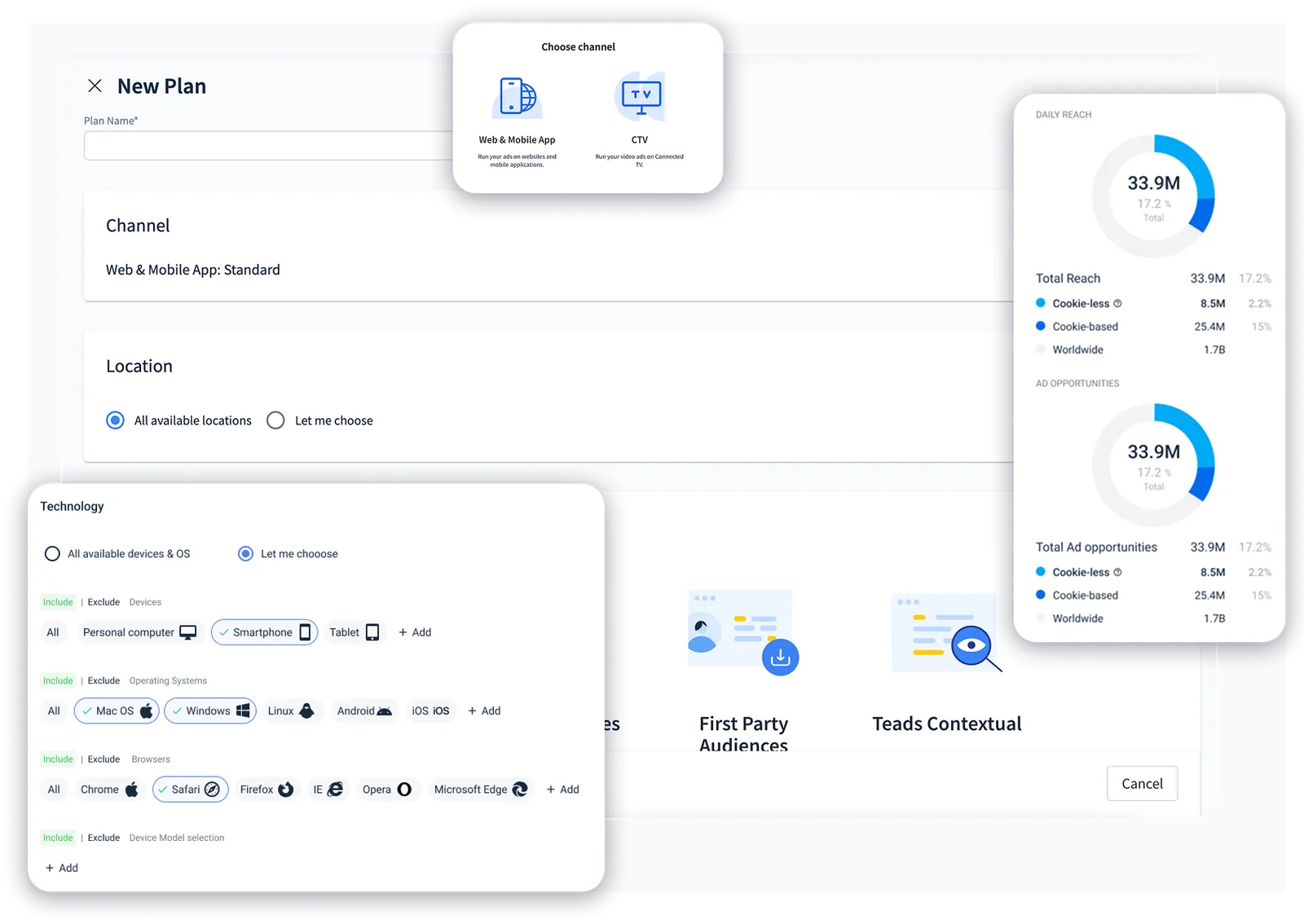
A dynamic form lowers cognitive load, because options change based on what the user selects.
Led to A dynamic planning form that shows options in context.
FINDING 2
Clear intersection and expanded audience
Intersections need to feel visual and immediate, not abstract.
Led to A visual model for audience intersections.
FINDING 3
Highlight cookieless
Cookie-less reach belongs front and center. It was a real differentiator.
Led to A reach chart that splits cookie-based and cookieless inventory.
FINDING 4
Unify planning with execution
Plans must flow into campaign setup. Planning can't be a dead end.
Led to A saved plans library that flows into campaign setup, so nothing is entered twice.
03 The decision
Make the data visible, and keep plans connected
I worked with the PM and with data, engineering and account management teams to turn technical audience concepts into something a self-serve advertiser could use without training.
- A dynamic planning form that shows options in context.
- A visual model for audience intersections.
- A reach chart that splits cookie-based and cookieless inventory.
- A saved plans library that flows into campaign setup, so nothing is entered twice.
04 Prototype
Visualizing logic, reach, and workflow continuity
Unusually for something this complex, the core structure held from the first iteration. Only the chart colors and illustration style changed afterwards.
High fidelity prototype
05 The outcome
From 0 to nearly half: powering Teads’ performance business
The performance business grew from 0% to nearly half of total platform revenue. The performance features I designed, which took the platform from branding into performance advertising, drove 65% year-over-year growth in that segment. Targeting Planner was one of several features built to bring performance clients to Teads, alongside Campaign Overview reworked for performance KPIs, Auction Report, Campaign Setup with the campaign objective and the Creative Editor. The new offering opened the platform to a category of advertiser who previously had no reason to use it.
06 Looking back
Discovery as an alignment tool
When stakeholders and users agree on the first pass, it usually means the problem was understood before any screens existed. The upfront discovery did that job here.